Adjusted EBITDA and the quality of earnings
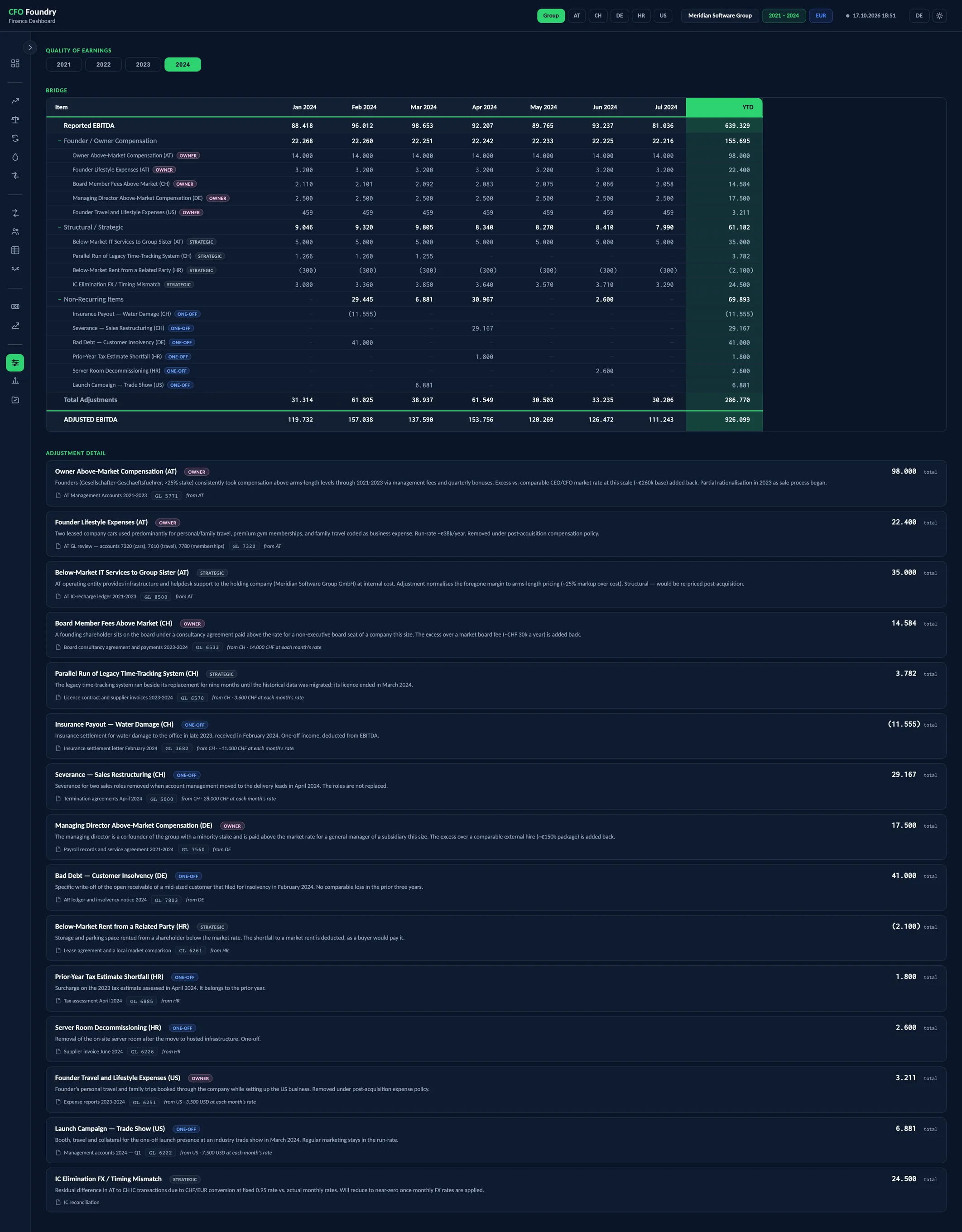
Reported EBITDA, the adjustments that normalise it and the earnings that remain, month by month and with the reason for each.
- BRIDGE
Meridian is a fictional demo company. All figures are sample data.
Key questions
What are the earnings after normalisation?
The bridge runs from reported EBITDA through each adjustment to adjusted EBITDA, for every month and the year to date.
Why is each adjustment there?
Each one carries its category, a rationale, the source document and, where there is one, the general ledger account.
Does an exceptional cost recur?
The quality of earnings workbook sets every adjustment against every fiscal year, so a cost that comes back each year shows as a full row.
Adjusted EBITDA and the QoE bridge
Every adjustment with its category, rationale, source and account, rolled into a monthly bridge from reported to adjusted EBITDA, with the year to date. The calculation a buyer will make, made first.
Adjustments
- Bridge
What an adjustment is
Reported EBITDA comes from the P&L, built from the trial balance. An adjustment is an amount the seller argues should be added back to it or deducted from it, because the business will not carry it after a sale. A positive amount raises EBITDA and a negative amount lowers it.
Adjustments are filed in categories the company names itself. Typical ones:
- Founder and owner compensation: pay above the market rate, private costs booked through the company
- Non-recurring items: a legal case, a relocation, a one-off project
- Structural items: costs or prices inside the group that change with the transaction
One reason per adjustment keeps each one open to be accepted or rejected on its own.
Entered once, month by month
Adjustments are entered on the Adjustments screen of the operator app, each with its evidence and an amount for each month it relates to. The report shows them and edits nothing, so every copy of a report states the same adjustments.
An adjustment belongs to one entity, in its own currency, or to the group as a whole. The group report shows every entity's adjustments, each marked with its entity, together with the group's own.
Each year has its own tab and lists only the adjustments that carry an amount in that year, grouped by category with a subtotal per category.
Where adjusted EBITDA is used
The P&L carries the adjustments under reported EBITDA, with adjusted EBITDA as their total. In a part year with twelve months of history, an LTM column stands beside the year to date.
The bridge to equity value in the Transaction view starts from adjusted EBITDA of the last twelve months, read from the same monthly figures.
The quality of earnings workbook
Every build writes a quality of earnings workbook into the data room's Quality of Earnings folder, for each entity with adjustments and for the group. It holds three sheets:
- The schedule: reported EBITDA, the adjustments by category and adjusted EBITDA for each fiscal year
- The month-by-month trail behind every figure in the schedule
- One row per adjustment with its rationale, source document and account
Subtotals, totals, adjusted EBITDA and the margins are formulas. Deleting the row of an adjustment re-foots the schedule.
Terms
- Reported EBITDA
- Earnings before interest, taxes, depreciation and amortisation, as the P&L states them.
- Adjusted EBITDA
- Reported EBITDA plus the add-backs and less the deductions: the earnings the business carries on its own.
- Add-Back
- An adjustment that raises EBITDA, for a cost that ends with the sale or does not recur.
- Quality of Earnings (QoE)
- The analysis of how far reported earnings reflect the lasting earning power of a business, with the evidence for each normalisation.
Data sources
- The monthly trial balance of each entity, for reported EBITDA
- The adjustments entered in the operator app, each with its months, category and evidence
- Monthly exchange rates, for entities that report in another currency
FAQ
How is adjusted EBITDA calculated?
Reported EBITDA plus the add-backs, less any deductions. CFO Foundry does this month by month, so adjusted EBITDA holds for every month, every year and the last twelve months.
What is the difference between EBITDA and adjusted EBITDA?
EBITDA is the figure in the accounts. Adjusted EBITDA removes the items a business will not carry after a sale, such as owner pay above the market rate or a one-off legal case.
Which add-backs are typical when selling a company?
Owner compensation above the market rate, private expenses booked through the company, one-off costs such as a legal case or a relocation, and costs that end with the transaction.
What is a quality of earnings report?
A schedule of reported EBITDA, each normalisation with its evidence and the adjusted figure that results, usually prepared for due diligence. CFO Foundry writes one into the data room with every build.
Get in touch
Describe your situation in a few lines. A reply typically follows within 1–2 business days.
To the Contact Form