Cash flow and liquidity
Where each month's cash came from and where it went, derived from the books the company already keeps.

- 4 KPIs
- CASH FLOW STATEMENT
- 4 KPIs
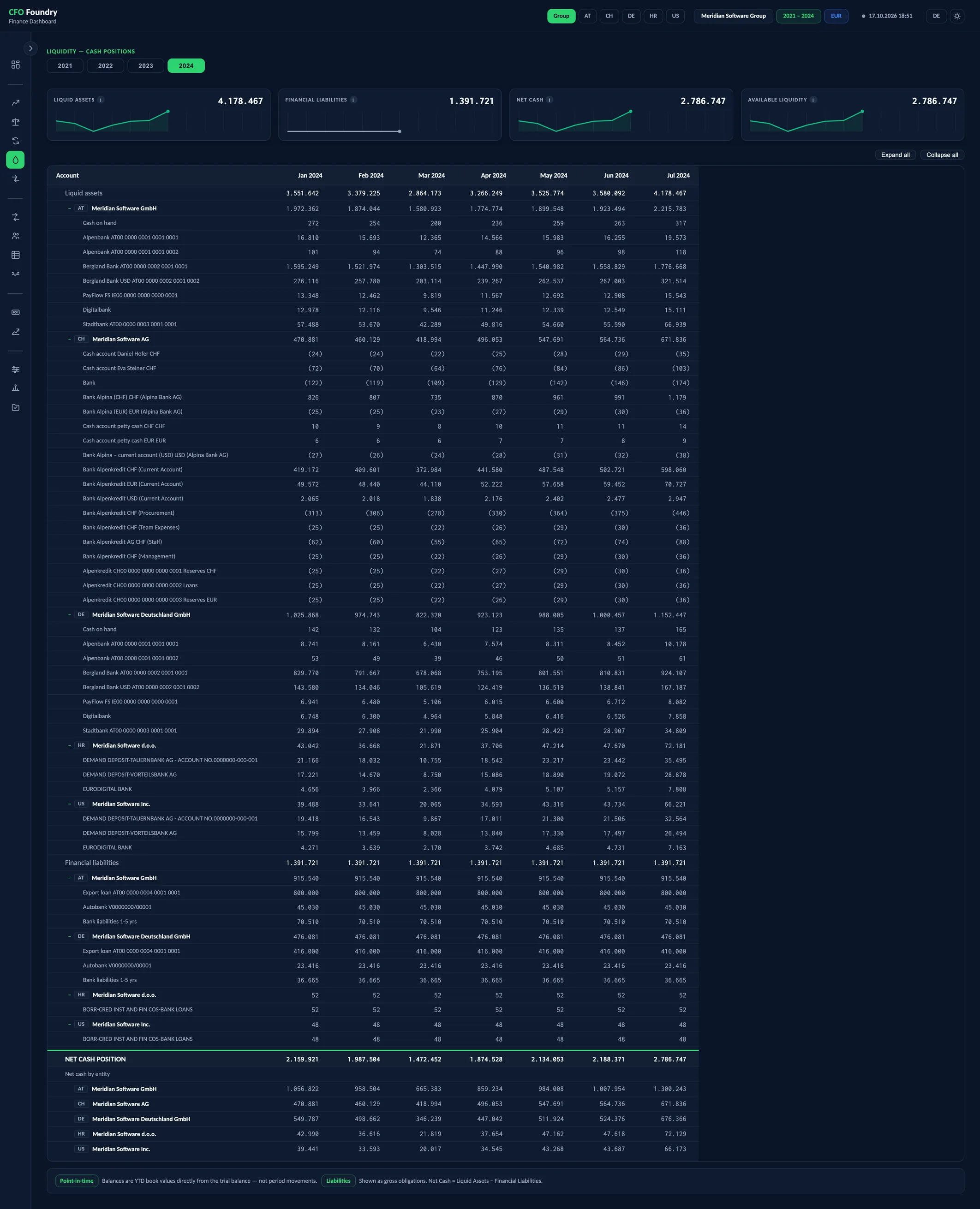
- LIQUIDITY — CASH POSITIONS
Meridian is a fictional demo company. All figures are sample data.
Key questions
Did the profit turn into cash?
Operating cash flow starts from net income and corrects it for non-cash items and the change in working capital.
Where did the cash go?
Investing and financing cash flow show what went into fixed assets and loans, and what came from or went to lenders and owners.
How much cash is available?
Available liquidity is net cash plus the undrawn part of the credit lines.
In CFO Foundry
The Excel Workbook
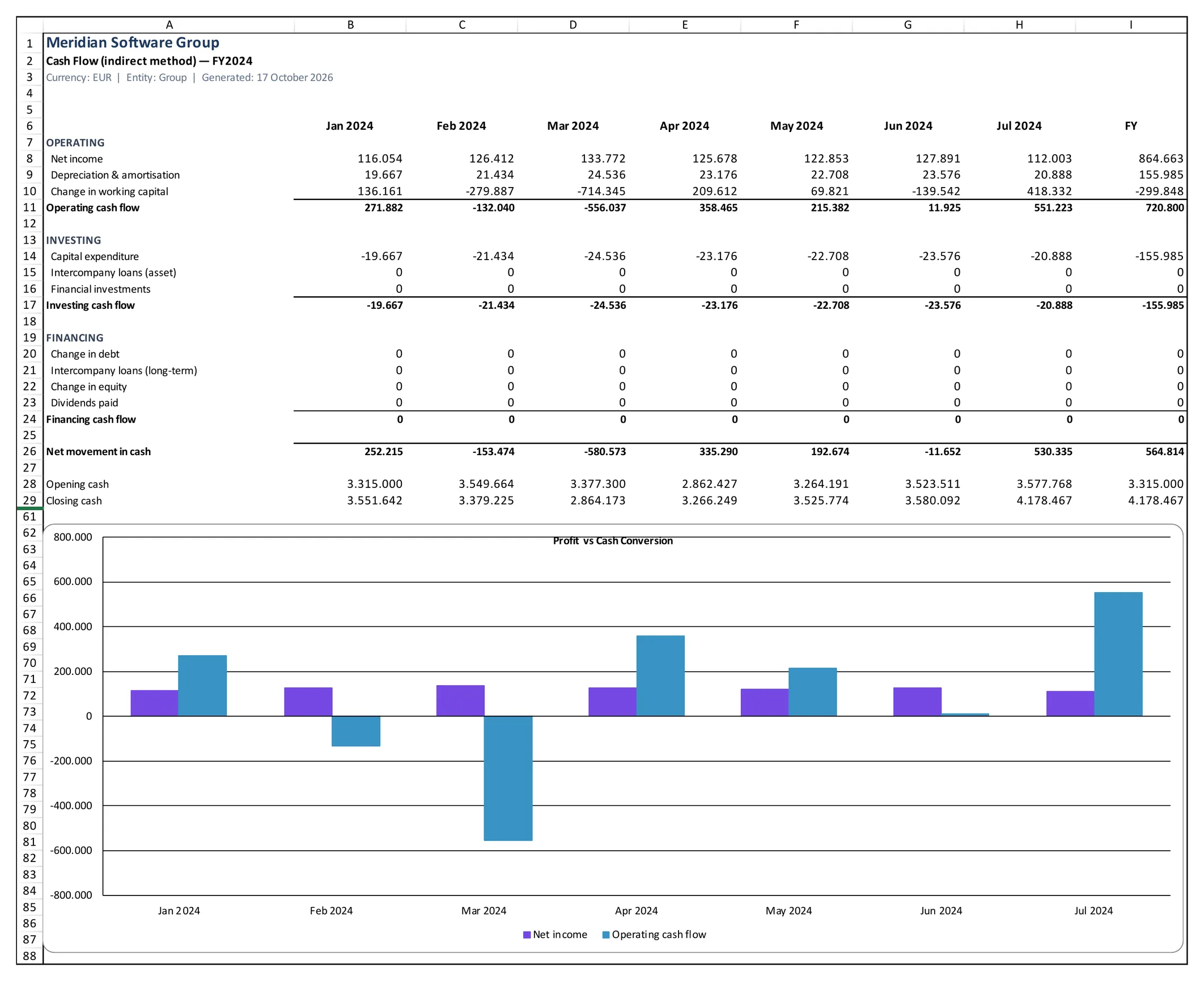
Download Excel exports the statement as a workbook, one per year. The subtotals and the net movement are formulas over the lines above them, and the view's charts sit under the statement.
Operating, investing, financing, plus the credit facilities
An indirect cash flow statement derived from the trial balance. The liquidity view shows cash, financial debt, net cash and available credit lines, for the group and for each entity.
Cash Flow
- Operating CF
- Investing CF
- Financing CF
- Net Cash Movement
- Cash position
- PROFIT vs CASH CONVERSION
- Working capital impact
- Cash bridge
- Cash flow statement
Liquidity
- Liquid Assets
- Financial Liabilities
- Net Cash
- Available Liquidity
- Liquidity — cash positions
Derived from two month-ends
The cash flow statement is derived from the balance sheet at two month-ends, by the indirect method. Every movement of cash lands in one of three sections.
- Operating: net income, depreciation and amortisation added back, and the change in net working capital
- Investing: fixed assets, loans to group companies and financial investments
- Financing: financial debt, capital paid in by the owners and distributions
The working capital in the operating section is the same net working capital as in the working capital view.
Opening cash to closing cash
Opening cash plus the three sections should equal closing cash at bank. Where a balance moved that none of the three sections covers, the difference stays visible as a line of its own, and the account mapping is where it is traced.
Liquidity and credit lines
The liquidity view lists every cash and bank account with its month-end balance, by entity. Financial liabilities are the current financial debt and the long-term bank loans, and net cash is cash at bank less financial liabilities.
Each credit line is recorded once with its limit, and its undrawn part adds to the available liquidity.
An overdrawn bank account stays a cash account with a negative balance. Moving it to liabilities is a booking decision, made in the books.
Terms
- Indirect Method
- A cash flow statement that starts from net income and works back to cash through the changes in the balance sheet.
- Operating Cash Flow
- The cash the operations brought in: net income corrected for non-cash items and the change in working capital.
- Net Cash
- Cash at bank less financial liabilities. A negative figure is net debt.
- Available Liquidity
- Net cash plus the undrawn part of the credit lines.
Data sources
- The monthly trial balance of each entity
- The account mapping: cash and bank accounts, fixed assets, financial debt, equity and working capital
- The credit lines, each with its limit
- Monthly exchange rates, for entities that report in another currency
FAQ
How is a cash flow statement derived from a trial balance?
By the indirect method: it starts from net income and works back to cash through the changes in the balance sheet between two month-ends. CFO Foundry derives it every month from the trial balances and the account mapping.
Why do profit and cash differ in a month?
Invoices that are not yet paid, supplier bills that are not yet due, depreciation, investment and loan repayments all move profit and cash apart.
Are bank statements needed?
The monthly trial balances and the account mapping are enough. Bank balances come from the cash and bank accounts in the trial balance.
Get in touch
Describe your situation in a few lines. A reply typically follows within 1–2 business days.
To the Contact Form