Mapping your chart of accounts to one standard
Each company's own chart of accounts, translated once into one standard, so every report reads every entity the same way.
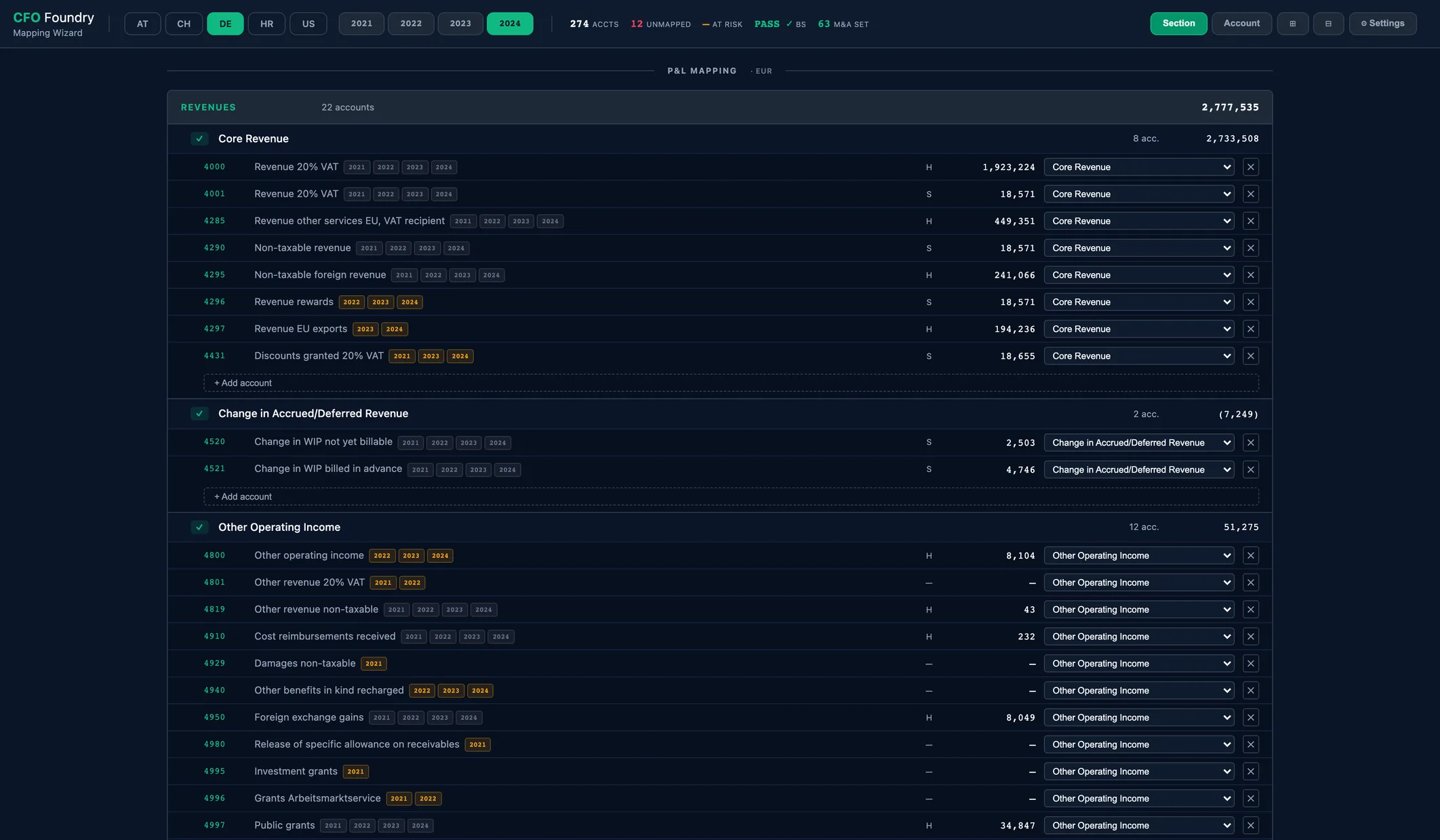
Meridian is a fictional demo company. All figures are sample data.
Key questions
Where does each account land?
On one P&L line or one balance sheet category of the standard chart, or in excluded, which leaves it out of both statements.
Does the balance sheet balance?
The header sets mapped assets against liabilities and equity, the year's result included, and shows PASS or the difference.
What is left to map?
The header counts the unmapped accounts and the balance on them, and a filter lists them.
Every account, mapped once
Each entity's chart of accounts is mapped once to the CFO Foundry standard chart: every account to a P&L line or a balance sheet category. A balance sheet account also carries its transaction treatment: working capital, cash, debt or excluded, exactly one, so nothing is counted twice. The balance check shows at once whether assets equal liabilities and equity. Only the account code decides where an account lands; its name is never read.
Platform
- Mapping Wizard: Every account mapped once to the standard chart, with a live balance check.
One standard chart
Every entity maps into the same standard chart, whatever its accounting system or its country. The P&L runs in sections, and the subtotals between them are calculated:
- Revenue, less external services, gives gross profit
- Personnel costs and other operating expenses lead to EBITDA
- Depreciation gives EBIT, the financial result EBT, and taxes net income
In a services company the people are the business, so internal staff sit in personnel and gross profit deducts external services only. The balance sheet has categories for non-current and current assets, equity and liabilities. Intercompany revenue, cost, receivables, payables and loans have lines of their own, so the group report can eliminate them.
Statements and accounts
The wizard shows the mapping as statements, line by line, and as one table of every account, with what is still unmapped at hand. The balances of any month in the data can be shown.
The transaction treatment
Each balance sheet account also carries one treatment: working capital, cash, debt or excluded. A category comes with its usual treatment, and a treatment set by hand is marked and can carry a note.
For an entity in another currency, a balance that is really a group-currency amount, such as a loan agreed in euros, can be held at the group currency.
Codes decide, and the mapping is kept
Where an account lands depends on its code and the mapping alone.
Saving keeps the previous version beside the new one. Lines renamed for the company's own statements show under their new names in the wizard.
Terms
- Chart of Accounts
- The company's own list of accounts, as kept in its accounting system.
- Standard Chart
- The one structure of P&L lines and balance sheet categories every entity maps into.
- Transaction Treatment
- Working capital, cash, debt or excluded: what a balance sheet account counts as in a sale.
- Balance Check
- Mapped assets against mapped liabilities and equity, including the year's result.
Data sources
- The monthly trial balances of the entity: every account found in them
- The standard chart and the company's own names for its lines
- The entity's saved mapping
FAQ
What is a chart of accounts mapping?
The assignment of every account in a company's own chart to a line or category of a reporting standard, so that figures from different charts can be read and added together.
Can entities with different charts of accounts be consolidated?
Yes, once each one is mapped to the same standard chart. The group report then adds them line by line, converted to the group currency.
Does the mapping have to be repeated every month?
No. It is done once per entity. After that, a month only brings the accounts that are new, and the header counts them until they are mapped.
Get in touch
Describe your situation in a few lines. A reply typically follows within 1–2 business days.
To the Contact Form