The budget, measured against every close
A budget built from the company's own drivers, locked for the year and held against the actuals month by month, with where the year will land.
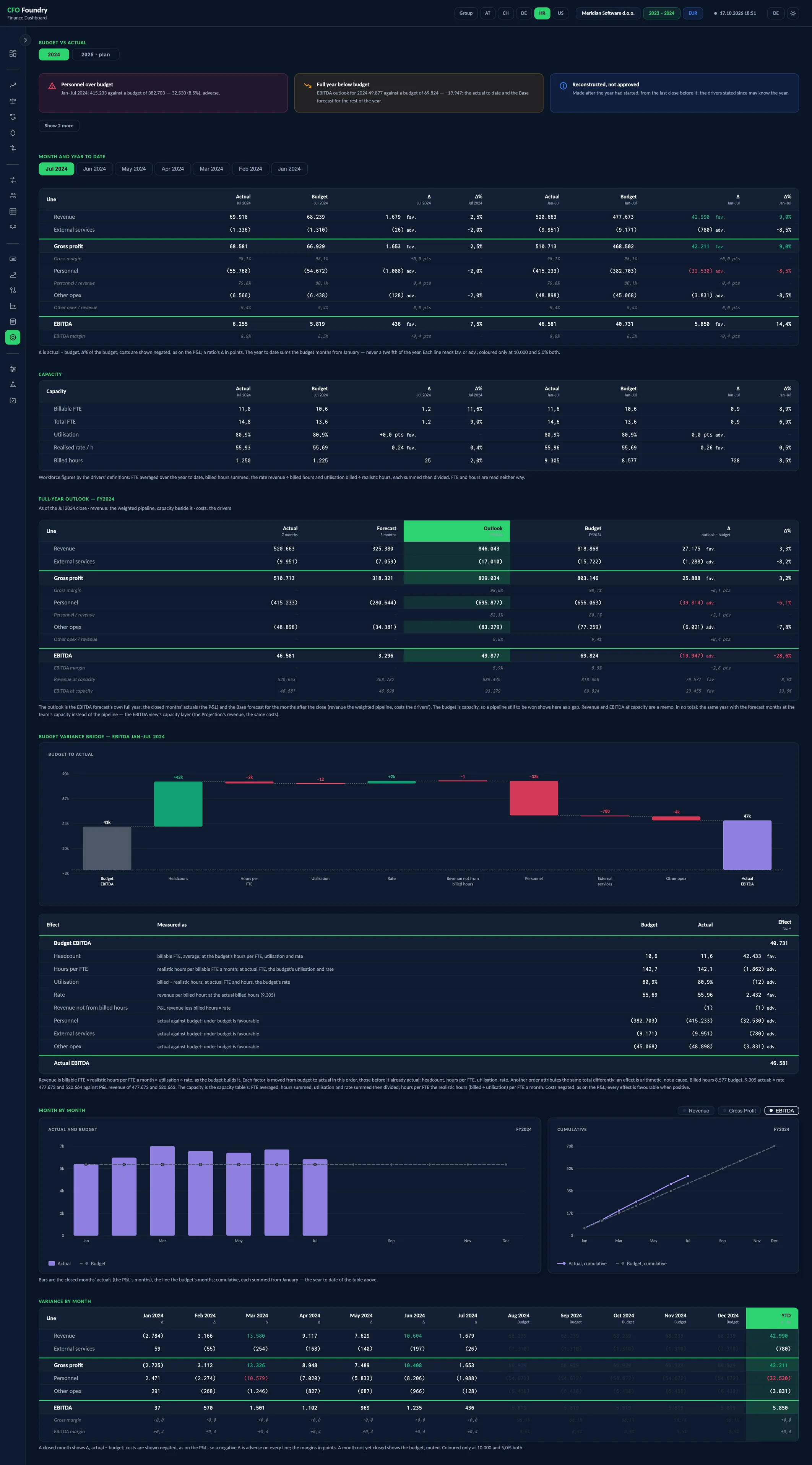
- MONTH AND YEAR TO DATE
- CAPACITY
- FULL-YEAR OUTLOOK — FY
- BUDGET TO ACTUAL
- VARIANCE BY MONTH
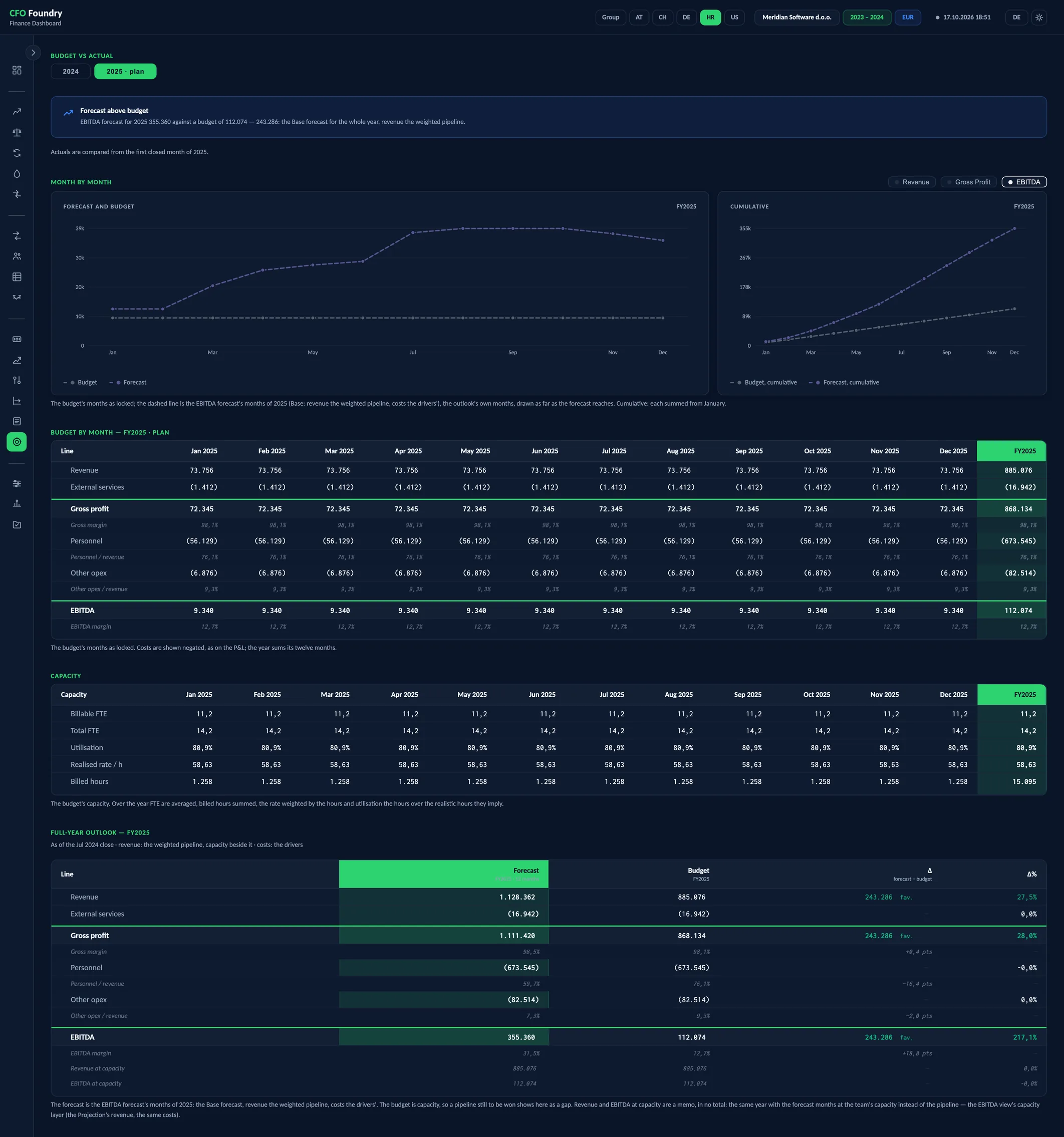
- BUDGET BY MONTH — FY · PLAN
- CAPACITY
- FULL-YEAR OUTLOOK — FY
Meridian is a fictional demo company. All figures are sample data.
Key questions
Are we on budget?
The month and the year to date stand beside the budget line by line, from revenue to EBITDA, each variance as an amount and a percentage and marked favourable or adverse.
Where will the year land?
The full-year outlook adds the forecast's remaining months to the actual to date and sets the total against the full-year budget.
Why are we off plan?
A bridge walks from budget EBITDA to actual EBITDA through headcount, hours, utilisation, rate and the cost lines. Its steps add up to the whole difference.
Budget against actual
A budget is the projection frozen for one year: the drivers and planned changes, plus levers of its own, locked as a version. Every close is measured against it, in the P&L, on the dashboard and on a page of its own, with the full-year outlook and the bridge from budget to actual EBITDA.
Budget
- 2024
- 2025 · plan
- Budget to actual
- Actual and budget
- Cumulative
- Forecast and budget
- Month and year to date
- Capacity
- Full-year outlook — FY
- Budget to actual
- Variance by month
- Budget by month — FY · plan
A budget from the drivers, locked as a version
The budget starts from the company's own drivers and planned changes, and adds levers and changes of its own: billable and overhead FTE, utilisation, the growth figures, and hires or cost changes for the plan alone. The forecasts never read them, so plan and forecast stay apart.
A budget is shaped as a draft on the operator app's Budget screen and rebuilt with every change. Locking it fixes it for good; a change after that is a new version, with the locked one as its parent and a reason. A budget made after its year has started is labelled reconstructed wherever it appears.
Every close against the budget
Once a budget is locked, every build compares the year with it:
- The P&L: the budget, the variance and the variance in percent beside the year to date
- The dashboard: an EBITDA vs Budget card for the month and the year to date
- The Budget page: month and year to date for any closed month, capacity against the budget, the charts and the variance month by month
- The Board Deck: the same card on its slide of the month
Each variance is read as favourable or adverse in words, and colour marks only the ones large enough to matter.
Where the year will land
The full-year outlook is the actual to date plus the EBITDA forecast's remaining months, held against the full-year budget.
Two memo rows show the same year with the remaining months at the team's capacity.
A locked budget for the coming year shows as the plan year before its first close: its months, its capacity and the outlook against it.
From budget EBITDA to actual EBITDA
The variance bridge runs from budget EBITDA to actual EBITDA for the year to date, as a waterfall and a table. Its steps are headcount, hours per FTE, utilisation and rate, then the revenue outside billed hours and the three cost lines: personnel, external services and other operating expenses.
The steps add up to the difference to the cent. Where hours or headcount are missing, revenue is one step and the page says why.
The group and the data room
The group report compares EBITDA: the entities' locked budgets, each month converted at the rate of its actual. An entity without a locked budget is named on the group P&L.
The budget stays out of the data room until the company discloses it. Then the P&L workbook carries the budget columns and a Budget sheet with the version, its months and the bridge, and a locked budget for the coming year gets a workbook of its own.
Terms
- Budget Version
- A budget for one entity and year under a name: a draft until it is locked, then fixed. A change is a new version.
- Budget Lever
- A driver figure a budget sets for itself, such as billable FTE or utilisation, stored in the budget alone.
- Full-Year Outlook
- The actual to date plus the forecast's remaining months, against the full-year budget.
- Variance Bridge
- The steps from budget EBITDA to actual EBITDA, adding up to the whole difference.
- Reconstructed Budget
- A budget made after its year had started, and labelled as such.
Data sources
- The monthly trial balance of each entity
- Monthly headcount and hours, for capacity and the bridge
- The drivers and planned changes, as the budget's starting point
- The budget versions made in the operator app
- The pipeline, for the full-year outlook
FAQ
What is a driver-based budget?
A budget built from the figures behind the result, such as headcount, utilisation, rate and cost per FTE. A target is reached by moving a driver, so every variance can be traced to one.
Why lock a budget?
A locked budget is a statement made before the year, and every close is measured against the same figures. A revision is a new version beside it.
What is a budget variance bridge?
A walk from budget EBITDA to actual EBITDA in steps, such as headcount, utilisation and rate, that add up to the whole difference.
Does the budget change the forecast?
The budget's own levers and changes are stored in the budget alone, and the forecasts run on the realistic drivers. Plan and forecast stay apart.
Get in touch
Describe your situation in a few lines. A reply typically follows within 1–2 business days.
To the Contact Form