The balance sheet, down to the account
Assets, liabilities and equity at every month-end, each line traced to the accounts of the trial balance behind it.
- 4 KPIs
- BALANCE SHEET
Meridian is a fictional demo company. All figures are sample data.
Key questions
What does the company own and owe at month-end?
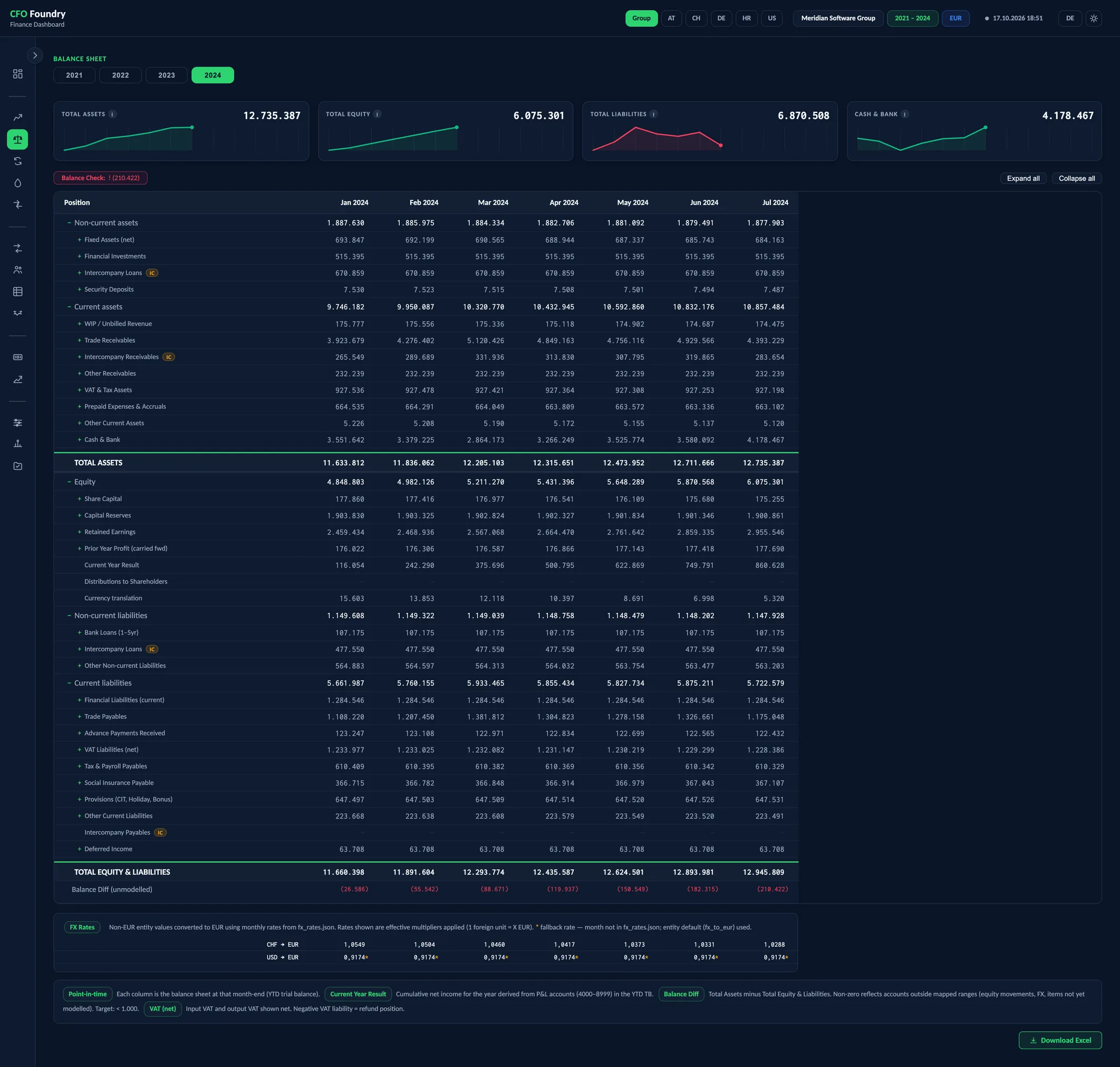
Five sections show non-current and current assets, equity, and non-current and current liabilities for every month of the year.
Which accounts make up a line?
Each line opens to its accounts, with account number, name and the balance at every month-end, signed as in the trial balance.
Does it balance?
A badge in the header compares assets with liabilities plus equity and shows the difference as soon as there is one.
The balance sheet, down to the account
Assets, liabilities and equity in collapsible sections, each line open to the accounts behind it. KPI cards with twelve-month trends for total assets, equity, net debt and cash. Multi-year tabs.
Balance Sheet
- Total Assets
- Total Equity
- Total Liabilities
- Cash & Bank
- Balance sheet
From the account to the line
Every balance sheet account is mapped to one category of the CFO Foundry standard chart, and each category is a line of the statement. A line is the sum of the accounts mapped to it, and nothing else. Typical lines in a services company:
- Fixed assets, financial investments, intercompany loans and security deposits
- Work in progress, trade and other receivables, prepaid expenses, VAT, cash and bank
- Share capital, reserves, retained earnings and the current year's result
- Financial debt, trade payables, tax and social insurance liabilities, provisions and deferred income
A bank account with a negative balance stays a cash account. Moving it to liabilities is a booking decision, made in the books.
Every line opens to its accounts
Each section carries its own total and opens to its lines, and each line opens to the accounts behind it. In an entity report the accounts follow the chart of accounts by number. In the group report they are ordered by size, each marked with its entity.
A line with many accounts opens to the largest first. A final row states how many more there are and what they come to, and one more click shows them all, so the accounts always add up to the line.
Intercompany loans, receivables and payables carry an IC badge in the line, so group balances stand apart from those with third parties.
The balance check and the trends
Total assets are compared with liabilities plus equity in every month. When they agree, the header shows a green tick. When they differ, the header shows the difference and a Balance Check row in the table shows it month by month. An unmapped account or a gap in the mapping shows up here first, and the account mapping is where it is traced.
Four cards above the statement show total assets, equity, total liabilities and net debt, or cash and bank where no debt is mapped, each with its trend over the months. Every year in the data has a tab of its own.
The company's own names, and the workbook
Sections, lines and the two headline totals can carry the company's own names in English and German, and lines can be reordered within their section. A line can be hidden while it holds no balance; once it holds one, it is shown again.
The balance sheet workbook lists the same accounts under each line. Each line is a sum of its accounts, each section a sum of its lines, and the Summary sheet reads its figures from Detail.
Terms
- Trial Balance
- The list of every account with its balance, exported from the accounting system each month.
- Standard Chart
- The one set of lines every entity's chart of accounts is mapped into, whatever its accounting system.
- Balance Check
- Total assets less liabilities and equity. Zero when the balance sheet balances.
- Net Debt
- Financial debt less cash, from the accounts the mapping treats as debt and as cash.
- IC
- Intercompany: a balance with another company of the same group.
Data sources
- The monthly trial balance of each entity, and the opening balance of each fiscal year
- The account mapping: the category of every balance sheet account
- The statement layout, where the company's own names and order are set
- Monthly exchange rates, for entities that report in another currency
FAQ
How is a balance sheet built from a trial balance?
Each balance sheet account is assigned to a line, and the line is the sum of its accounts at the month-end. CFO Foundry keeps that assignment in the account mapping and applies it to every month.
Why would a balance sheet not balance?
Usually an account that is not mapped, mapped to the wrong side, or missing from the export. The balance check shows the difference in the month it appears, and the accounts under each line show where it sits.
Can the balance sheet use the accountant's line names?
Yes. Sections and lines take the company's own names in English and German. Account names stay as they are in the trial balance.
Get in touch
Describe your situation in a few lines. A reply typically follows within 1–2 business days.
To the Contact Form